Earlier missions, instruments and projects I have worked on, from my PhD at the Open University's Centre for Electronic Imaging through to the sounding rockets flown from Penn State. For current work, see Current Research.
Proposed space missions · Flown space missions · Sub-orbital rockets · High-altitude balloons · Detector development · Reflection gratings · PhD and fellowships · Test facilities and institutions
Proposed space missions
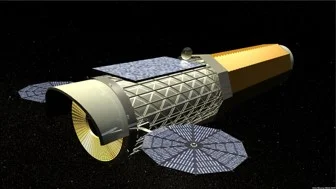
IXO – International X-ray Observatory
A planned observatory-class X-ray mission covering 0.1–40 keV, ranked fourth in the 2010 NASA decadal survey and subsequently cancelled. A collaboration of the CEI, the Universities of Iowa and Colorado, Northrop Grumman and e2v studied an off-plane grating spectrometer for IXO to find the missing baryons in the Warm-Hot Intergalactic Medium (WHIM).
My role: At the CEI, I studied the type, number and orientation of detectors for the spectrometer camera, with the goal of an EM-CCD focal plane array.
Papers: Tutt 2010 · Murray 2010 · McEntaffer 2010 · Holland 2009
Photos: IXO meeting, Boulder, Colorado (February 2010)
More detail
IXO aimed to address black hole formation and evolution, the neutron star equation of state, galaxy velocity structure, mass and metallicity, the nature of the cosmic web of baryons, and how feedback mechanisms in the Universe work. The off-plane grating spectrometer would have resolved separate absorption lines generated in the WHIM.
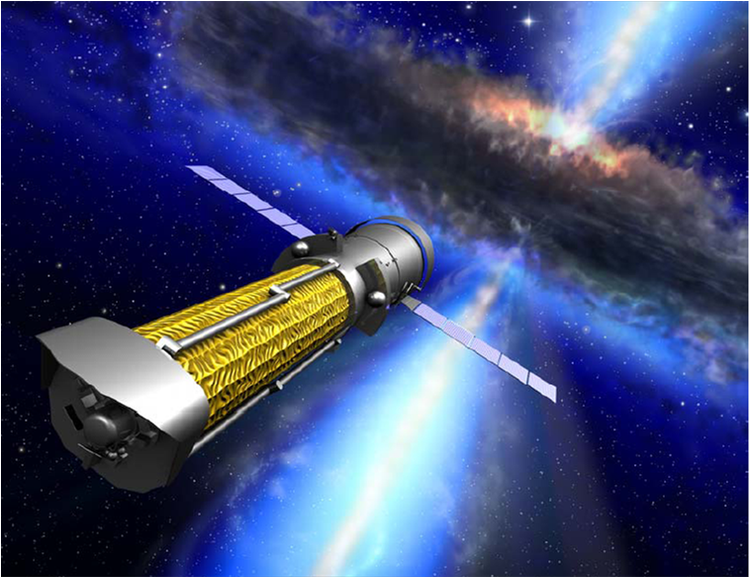
Image courtesy of ESA
ATHENA – Advanced Telescope for High ENergy Astrophysics
After IXO was cancelled, ESA proposed a scaled-down, Europe-only version, ATHENA, focused on black hole and accretion physics, cosmic feedback and large-scale structure. It was not initially selected (the L-class slot went to JUICE), but was later re-proposed and, after a 2023 redesign as NewAthena, is planned for adoption by ESA in 2027 and launch in 2037.
My role: Involved in mission planning as part of the European members of the IXO off-plane grating spectrometer team.
Links: NewAthena at ESA
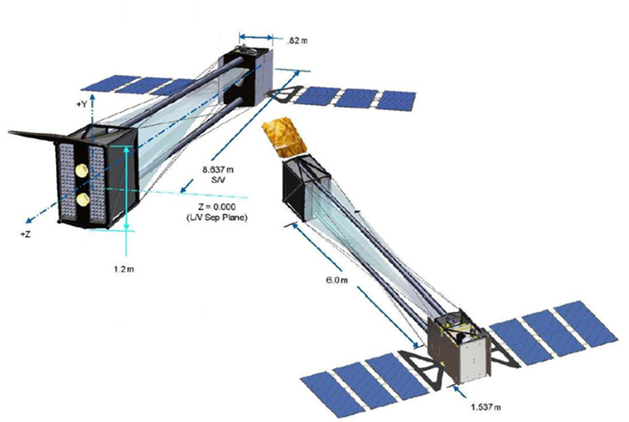
WHIMEx – Warm-Hot Intergalactic Medium Explorer
A proposed Explorer-class mission flying a small-area X-ray optic with off-plane gratings dispersing onto a CCD camera array – a more affordable way to meet many of IXO's science goals. It was not selected.
My role: Detector development at the CEI, including soft X-ray quantum efficiency testing of the baseline Hamamatsu CCDs with Osaka University.
Links: WHIMEx concept (PDF)
More detail
WHIMEx planned to address what happens close to a black hole, when and how supermassive black holes grew, how large-scale structure evolves, the link between supermassive black hole formation and large-scale structure, and how matter behaves at very high density.
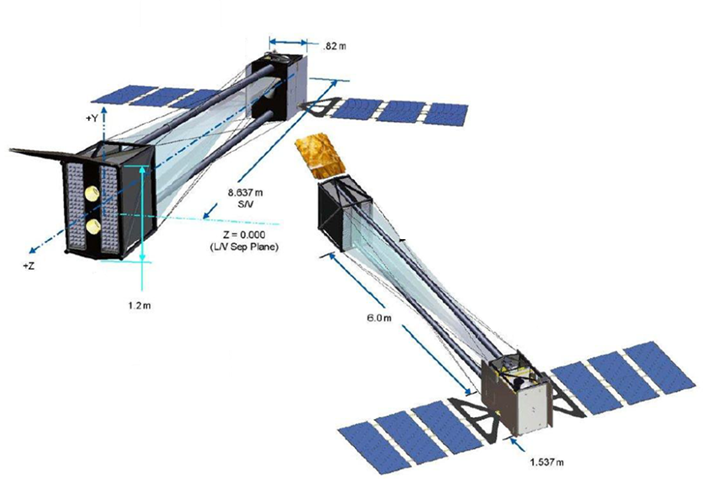
Image courtesy of Randall McEntaffer

Arcus
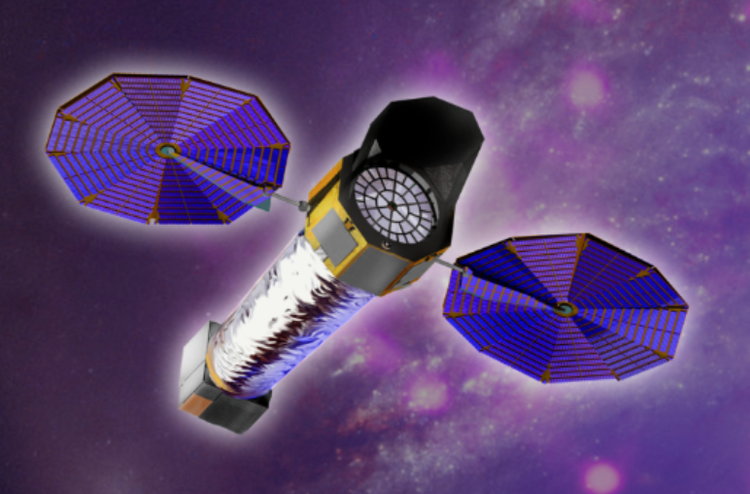
A proposed X-ray grating spectrometer mission using silicon pore optics and critical-angle transmission gratings, designed for a resolution of 2800 and ~800 cm² effective area over 0.25–1.5 keV. Arcus was selected for a Phase A study in 2017 and was one of two missions considered for Phase B in 2019; SPHEREx was selected.
My role: Tested the critical-angle transmission gratings and helped design the test facility that would have been used in Phase B.
More detail
Arcus would have studied how matter cycles in and out of galaxies and clusters, how black holes grow and affect their surroundings, and how stellar systems, stars and protoplanetary disks form and evolve.
Lynx X-ray Observatory
The high-energy flagship concept studied by NASA for the 2020 Astrophysics Decadal Survey, combining high angular resolution, throughput, field of view and spectral resolution. The survey recommended the Habitable Worlds Observatory as NASA's next flagship, so Lynx was not taken forward as proposed.
My role: Member of the optics and instrument working groups, contributing expertise on alternative detectors and optical blocking filters.
Papers: Gaskin 2017
More detail
Lynx's three science drivers were the dawn of black holes, the drivers of galaxy evolution, and the energetic side of stellar evolution.
Flown space missions

Euclid
An ESA mission, launched in July 2023, mapping the geometry of the dark Universe through weak gravitational lensing and baryonic acoustic oscillations. Weak lensing demands excellent image quality, and so detectors with high tolerance to radiation damage.
My role: At the CEI, helped characterize radiation damage in prototype CCD204 detectors for Euclid's VIS instrument.
Links: Euclid at ESA

ASTRO-H (Hitomi)
JAXA's sixth dedicated X-ray satellite, carrying hard X-ray telescopes, a high-resolution microcalorimeter and a Soft X-ray Imager. It launched in February 2016 but was lost about a month later after a failure of its attitude control system.
My role: Worked with Hiroshi Tsunemi's group at Osaka University on the Soft X-ray Imager (SXI) CCD camera system, including during a 2013 JSPS fellowship.
Links: ASTRO-H at JAXA · SXI paper (2018)
More detail
ASTRO-H aimed to make some of the first imaging and spectroscopic observations with a hard X-ray telescope, the first spectroscopy with a very high resolution microcalorimeter, and the most sensitive wide-band observations from 0.3 to 600 keV. Its instruments were the Hard X-ray Telescope, Soft X-ray Telescope, Hard X-ray Imager, Soft X-ray Spectrometer, Soft X-ray Imager and Soft Gamma-ray Detector.
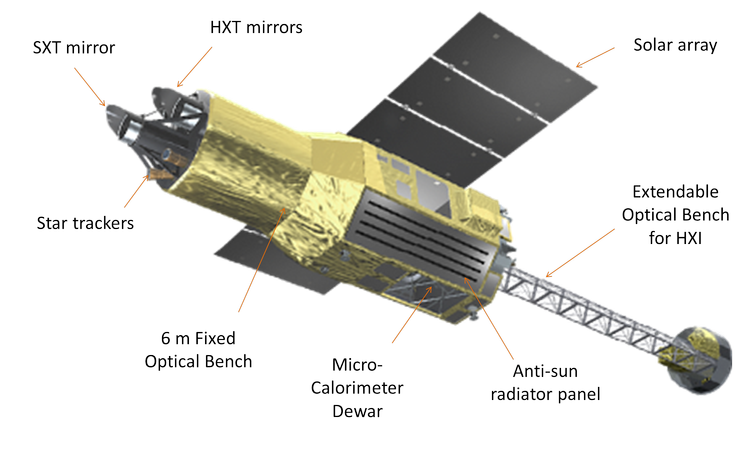
Image courtesy of JAXA
Sub-orbital rockets

OGRESS – Off-plane Grating Rocket for Extended Source Spectroscopy
A sounding rocket payload with two moderate-resolution (E/ΔE ~ 10–40) soft X-ray spectrographs covering 0.3–1.2 keV, with a field of view large enough for diffuse sources. It launched from White Sands Missile Range on 2 May 2015 to observe the Cygnus Loop supernova remnant.
My role: Mechanical engineer.
Papers: Rogers 2015 · Rogers 2017
Photos: OGRESS · Launch, May 2015
More detail
OGRESS used the same optical design as CODEX, EXOS and CyXESS. Light for each spectrograph was collected by a passive focuser – a stack of wire grids that sculpts a converging beam – feeding an array of off-plane gratings about 2 m from the Gaseous Electron Multiplier (GEM) detectors. The Cygnus Loop is a middle-aged (5–8 kyr) shell-type remnant about 540 pc away spanning ~3° × 3°; the observations were designed to determine its dominant soft X-ray emission mechanism and the equilibrium state and abundances of the plasma.
In the news & videos
- Launch video, consecutive camera views (May 2015)
- Launch video, split screen (May 2015)
- University of Iowa news release: UI researchers launch rockets in search of unseen parts of universe (March 2015)
WRXR – Water Recovery X-ray Rocket
A re-flight of the upgraded OGRESS payload, targeting soft X-rays (0.25–0.8 keV) from the Vela supernova remnant to measure oxygen and carbon emission lines. It launched on 4 April 2018 from Roi-Namur, Kwajalein Atoll, using NASA's water recovery technology to bring the payload back from the ocean.
My role: Led the team that co-aligned the off-plane reflection gratings into a module and aligned the mirrors directing X-rays onto the detector; lead mechanical engineer, assisting the lead systems engineer.
Papers: Tutt 2019 · Miles 2019 · Wages 2019 · Urban 2021
Photos, build-up and testing: Final rocket build-up at Penn State · Packing · Final rocket build-up · Alignment · GPS rollout · H1RG vibration test · Moment of inertia · Sequence testing · Spin balance · Telemetry integration · Vibration testing
Photos, Kwajalein launch campaign: Fishing · Launch night · R&R · Roi Namur · Snorkeling · Sunrise and Sunset · The Rocket · Third Island - Enubirr · Travel · WWII Memorial Tour · Videos
More detail
OGRESS's hardware worked, but a large background attributed to the high electric field of its GEM detectors swamped the X-rays from Cygnus. For WRXR the GEMs were replaced with a Hybrid CMOS Detector (HCD). The HCD is smaller (35 × 35 mm) and only one channel was used, so new, larger off-plane gratings (100 × 110 mm) operating at a shallower graze angle (2.2° rather than 4.4°) recovered some of the lost effective area.
The second channel carried a lobster-eye experiment from the Czech Technical University in Prague and Rigaku, with 1D and 2D lobster-eye optics focusing onto Timepix detectors. The payload also carried an instrument from Dynamic Imaging Analytics (samCAM) and the SuGRE-1 outreach experiment, tracking student-designed sculptures in microgravity.
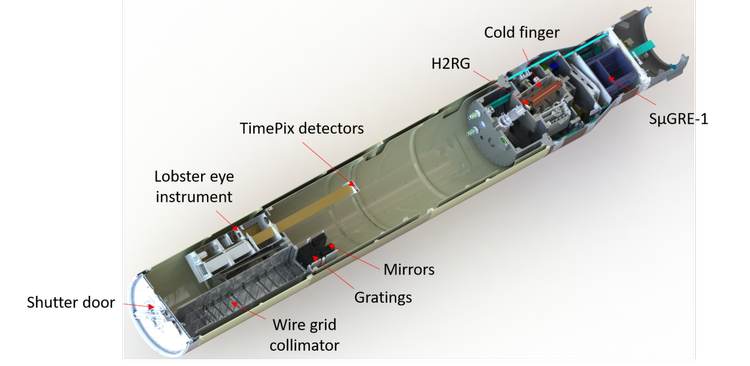
CAD of WRXR showing the optics (wire-grid collimator), telescope volume and detector, plus the lobster-eye experiment.
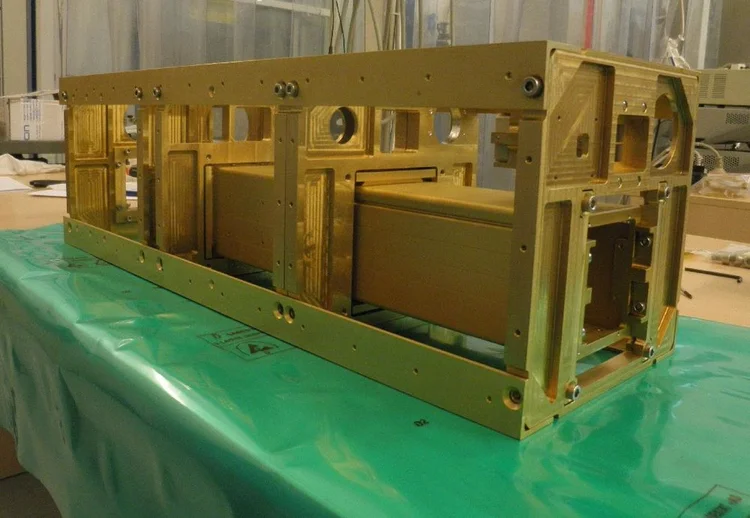
The lobster-eye instrument in flight assembly state.
In the news & videos
- Virtual-reality tour of the WRXR rocket, Alex Fatemi, Penn State (April 2020)
- Flight videos: SuGRE-1 (2D) · samCAM (2D) (July 2018)
- NASA Sounding Rocket Program Office: Rocket Report, Q2 2018
- Kwajalein Hourglass: NASA, physicists, students launch spectrographs from Roi-Namur (April 2018)
- Popular Mechanics: Meet the space cowboys launching telescopes from the middle of nowhere (April 2018)
- Daily Collegian: How a group of Penn State ‘space geeks’ partnered with NASA to send a rocket into orbit (April 2018)
- Launch livestream: just the launch · full broadcast (launch about an hour in) (4 April 2018)
- An in-depth look at the hardware inside WRX-R (April 2018)
- Eberly College of Science: NASA set to launch Penn State led experiment (March 2018)
- NASA Wallops Flight Facility: NASA rocket experiments to examine lifecycle of stars (March 2018)
- NASA Wallops Flight Facility: press release (January 2018)
- Interviews by the SuGRE-1 team: Prof. Randall McEntaffer (January 2018) · Ted Schultz (December 2017)
- YouTube channels: SuGRE-1 · McEntaffer Group (archive)
The tREXS rockets (first flown in 2022) and OGRE are described on Current Research.
High-altitude balloons

PUEO – Payload for Ultrahigh Energy Observations
A next-generation NASA long-duration balloon experiment designed to detect ultra-high-energy neutrinos with energies above 1 EeV (1018 eV). PUEO is the successor to the Antarctic Impulsive Transient Antenna (ANITA), promising more than an order-of-magnitude improvement in sensitivity. My balloon work continues with PBR.
My role: Designed and built the ground calibration power supply.
Detector development
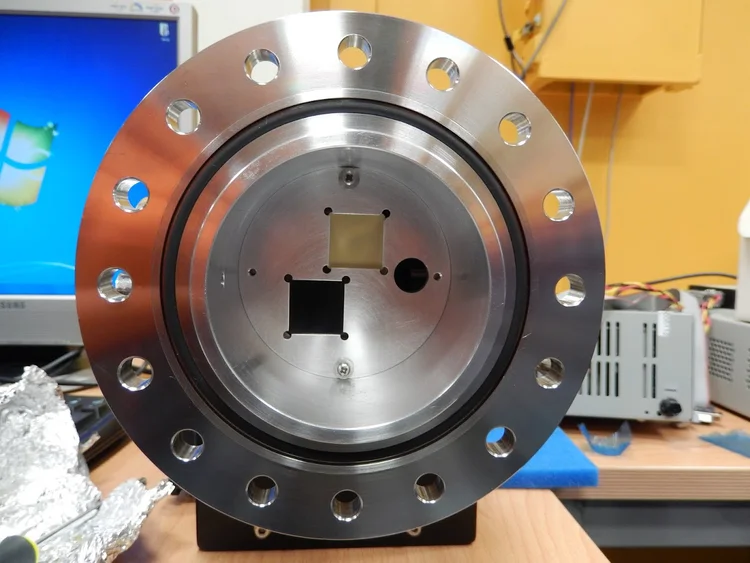
High-speed EM-CCD camera system
An STFC-funded development of a large-area, high-speed, photon-counting X-ray detector for synchrotron applications, coupling a scintillator and fibre-optic taper to an EM-CCD. The EM-CCD's gain register reduces the effective read noise to sub-electron levels, allowing single-photon analysis at high frame rates.
My role: Lead developer of the camera system and its characterization at Diamond B16.
Papers: Tutt 2014 (JINST) · Tutt 2014 (Electronics Letters)
Photos: B16 at the Diamond Light Source
More detail
Conventional X-ray imagers either use CMOS-hybrid technology, which limits pixel size and spatial resolution, or CCDs, whose readout speed is limited by noise. An earlier concept study had shown that a small (8 × 8 mm) scintillator-coupled EM-CCD could photon-count at 2 fps. This project used the high-speed electronics from the 'Lucky Imaging' work at the Institute of Astronomy, Cambridge, with a fibre-optic taper giving a 44-fold increase in area, and also tested scintillating fibre optics. Target applications include macromolecular crystallography, surface diffraction, small-angle scattering, high-energy X-ray diffraction and phase-contrast imaging, with e2v technologies as industrial partner.
Quantum efficiency testing
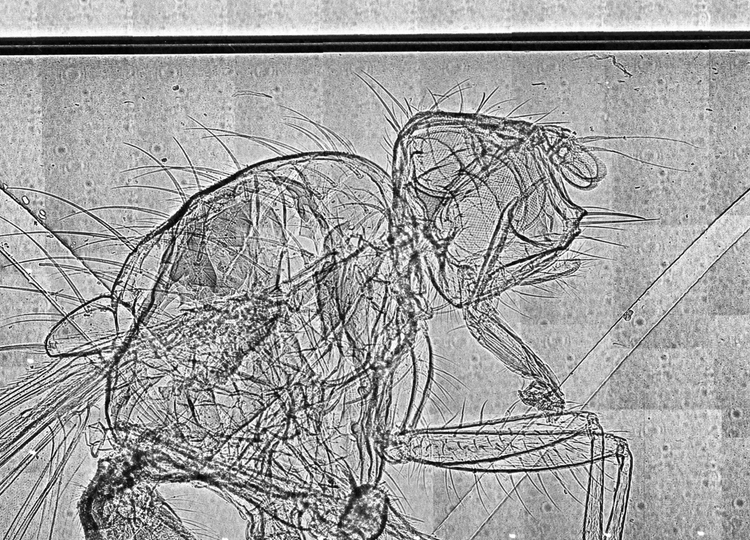
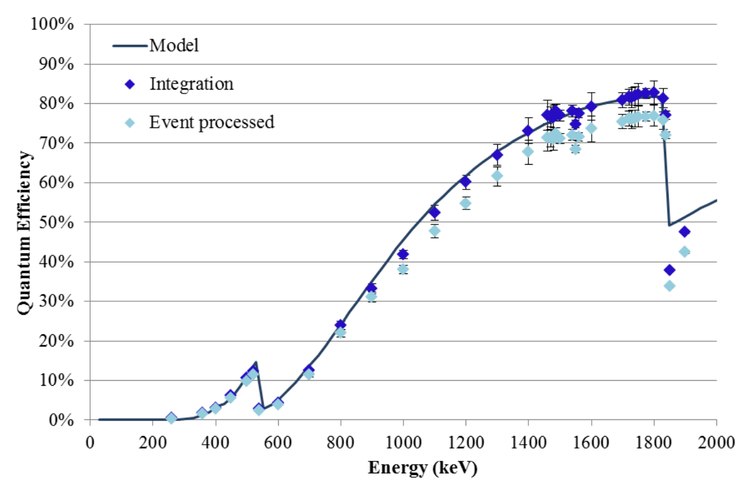
Soft X-ray quantum efficiency measurements at the PTB beamline at BESSY II, Berlin, including the e2v CCD236 swept charge device for India's Chandrayaan-2 CLASS instrument and China's HXMT, and the Hamamatsu CCDs baselined for WHIMEx.
My role: Carried out the QE measurements at PTB, BESSY II.
Papers: Smith 2014
Photos: PTB at BESSY II
More detail
The CCD236 is a 20 × 20 mm swept charge device for 0.8–10 keV spectroscopy. Its QE was measured relative to a NIST-calibrated photodiode over 0.2–1.9 keV, comparing two event-counting methods and mapping uniformity between 0.52 and 1.5 keV, giving an instrument-specific QE estimate for CLASS. The Hamamatsu devices were measured from 150 to 1900 eV over the WHIMEx bandpass.
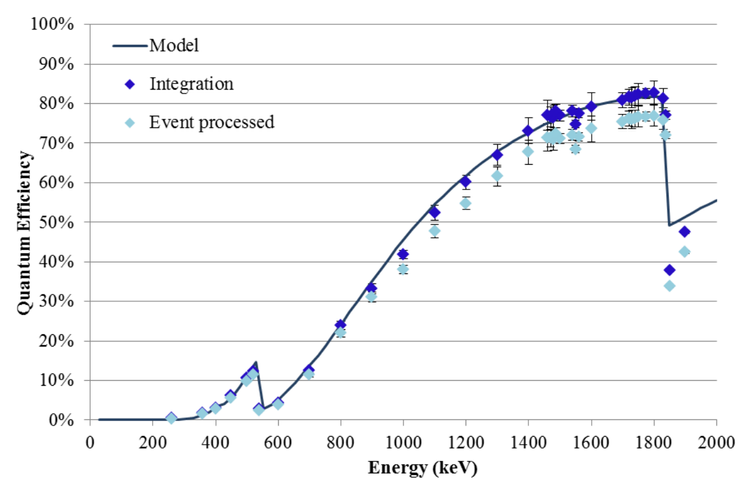
Quantum efficiency of the CCD236 between 50 eV and 2 keV.
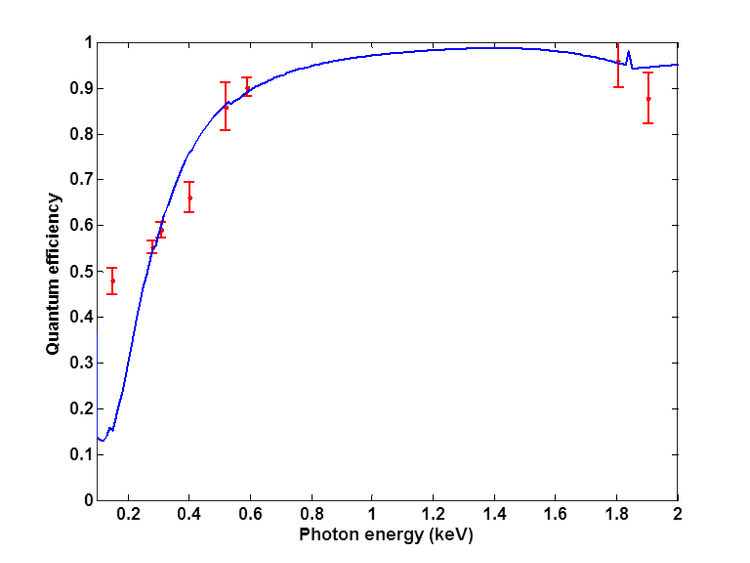
Quantum efficiency of the Hamamatsu CCDs over the WHIMEx bandpass.
Detector characterization
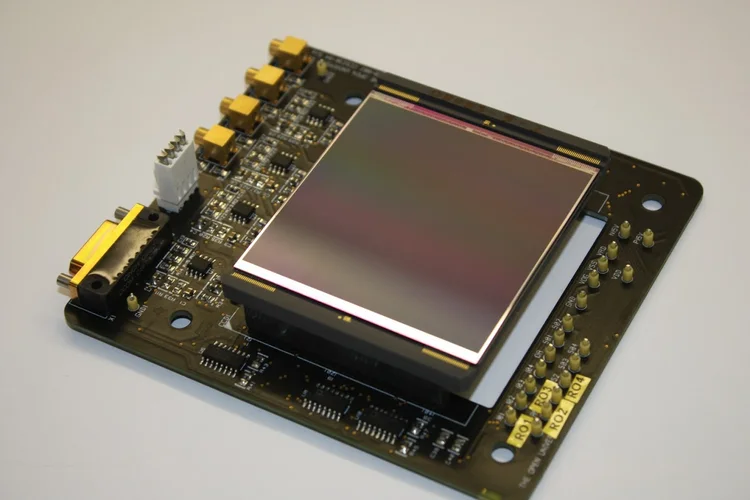
Characterization of a wide range of silicon-based detectors, including e2v CCD30-11, CCD42-10, CCD97, CCD201, CCD204 (Euclid VIS prototypes), CCD207-20 and -40, CCD220, CCD230-84 and CCD282, and the ASTRO-H SXI. I also ran a CCD workshop teaching the basics of CCD operation on the CCD30-11.
My role: Characterized these devices and ran the CCD workshop.
Photos: CCDs · ASTRO-H SXI · CCD30-11 · CCD42-10 · CCD97 · CCD201 · CCD207-20 · CCD207-40 · CCD220 · CCD230-84 · CCD282 · RandyCAM 2.0
Reflection gratings
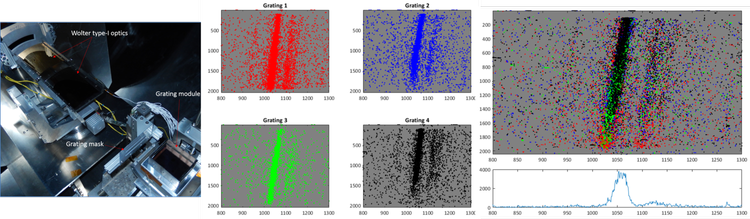
Grating alignment, resolution and diffraction efficiency
Development of off-plane X-ray reflection gratings at the University of Iowa – densely ruled, radially grooved, blazed and closely packed – and of a hexapod-based setup to co-align them. Four co-aligned gratings were verified at Marshall Space Flight Center in 2016 and survived vibration and thermal testing. Grating resolving power above 3000 was demonstrated at Marshall and at MPE PANTER.
My role: Designed the grating alignment setup and carried out the diffraction efficiency testing at PTB, BESSY II.
Papers: Donovan 2018 · Tutt 2016 · Marlowe 2015 · McEntaffer 2013
Photos: PANTER · PTB at BESSY II · Vibration testing at Wallops
More detail
The alignment setup, designed in SolidWorks, uses a hexapod to access all six degrees of freedom. Pitch and roll are measured with a theodolite and Shack-Hartmann sensor, yaw with an optical laser diffracted from an optical grating on the X-ray grating, and x, y and z are constrained with kinematic mounts.
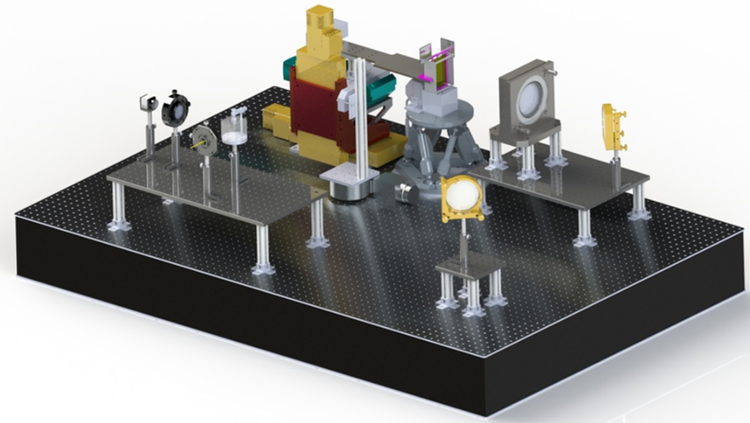
CAD of the grating alignment setup developed at the University of Iowa.
The PANTER test was the first to test two gratings co-aligned to each other in the converging beam of a silicon pore optic provided by cosine. Diffraction efficiency was measured at the PTB EUV reflectometer at BESSY II between 300 and 2000 eV in 50 eV steps across all visible orders.
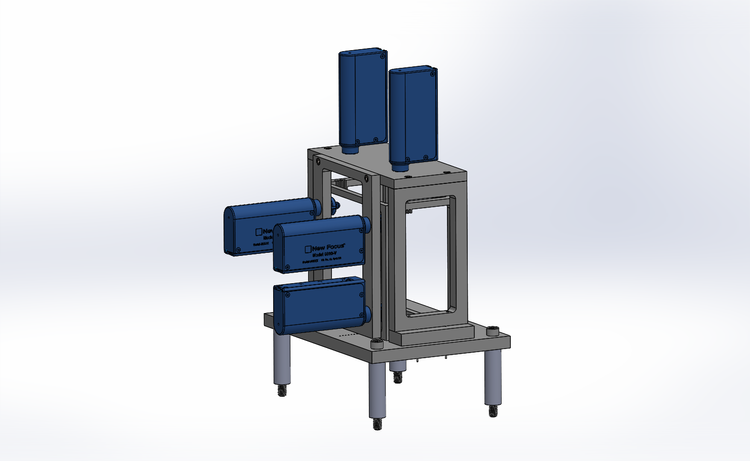
CAD of the active grating alignment module used at PANTER.
Video: Grating alignment
PhD and fellowships
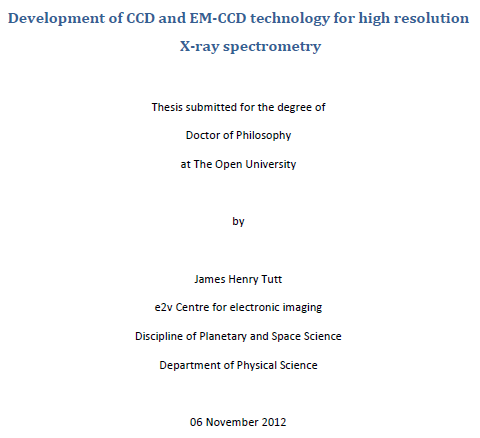
PhD – Development of CCD and EM-CCD technology for high resolution X-ray spectrometry
The Open University, 2012. The thesis covers the spectral resolution and quantum efficiency of CCDs and EM-CCDs for soft X-ray spectroscopy, including back-illuminated devices, thin filters and passivation.
My role: PhD researcher at the Centre for Electronic Imaging (CEI), The Open University.
Read the thesis
Photos: FIBSEM of an EM-CCD, March 2010
Abstract
Chapters 1–5 cover the background and theory of semiconductor detectors for high-resolution X-ray spectrometers. Chapter 6 compares the soft X-ray performance of three types of conventional CCD at the PTB beamline at BESSY II, showing spectral resolution degradation below 500 eV from incomplete charge collection and peak asymmetry; the Hamamatsu device degrades faster, attributed to its thicker active silicon (>50 μm) and dead layer (~75 nm). Chapter 7 predicts, models and experimentally verifies the Modified Fano Factor describing spectral resolution degradation when an EM-CCD directly detects soft X-rays. Chapter 8 presents work for the phase 0 study of the IXO off-plane grating spectrometer, including contamination, effective area, pointing knowledge and optical filters.

JSPS Summer Fellowship, Osaka, Japan
11 June to 21 August 2013. A two-month Japan Society for the Promotion of Science fellowship working with Hiroshi Tsunemi's group at Osaka University on the ASTRO-H Soft X-ray Imager CCD camera system.
My role: JSPS Summer Fellow.
Poster · Poster abstract · Final report · Presentation · Blog
See the Publications page for a full list of papers.
Test facilities and institutions
X-ray instruments have to be calibrated before they fly, so much of my work has taken place at beamlines, test chambers and launch ranges around the world.

PTB at BESSY II, Berlin, Germany
The Physikalisch-Technische Bundesanstalt (PTB) is Germany’s national metrology institute. Its beamlines at the BESSY II synchrotron let me test CCD performance over a precisely known range of X-ray energies, and I became a visiting researcher there through repeated campaigns.
More: PTB · BESSY II
Photos: PTB at BESSY II · April 2010 · November 2011 · June 2012 · October 2012 · March 2013 · May 2013

MPE PANTER X-ray Test Facility, Munich, Germany
The Max Planck Institute for Extraterrestrial Physics’ PANTER facility is a 130 m long X-ray test facility in Neuried, on the southwest outskirts of Munich, originally built to support development of the ROSAT telescope. Its main chamber is 12 m long and 3.5 m in diameter. I have taken part in many test campaigns at PANTER and worked on commissioning an X-ray camera system for the main chamber.
More: PANTER
Photos: PANTER, October 2014

Diamond Light Source, Harwell, UK
The UK’s national synchrotron facility in Oxfordshire. I worked on beamline B16 while developing a high-speed, low-noise camera system for high-energy X-ray detection in medical applications.
More: Diamond Light Source
Photos: B16 at the Diamond Light Source
Other test facilities and launch ranges
- Paul Scherrer Institute, Swiss Light Source (Switzerland) · photos, May 2011
- NASA Goddard X-ray Interferometry Testbed (Greenbelt, MD) · photos, 600 m beamline, January 2014
- NASA Marshall Space Flight Center Stray Light Facility (Huntsville, AL)
- NASA Wallops Flight Facility (Wallops Island, VA) · photos, grating module vibration testing, March 2016
- White Sands Missile Range (NM)
- Ronald Reagan Ballistic Missile Defense Test Site (Roi-Namur, Kwajalein Atoll, Marshall Islands)
- Poker Flat Research Range (Fairbanks, AK)
- SPring-8 (Hyōgo Prefecture, Japan)
- CXRO Reflectometer at the Advanced Light Source (Lawrence Berkeley National Laboratory)
Institutions and collaborators
- Penn State University, Department of Astronomy and Astrophysics – current employer · photos
- University of Iowa – ongoing collaboration on X-ray instrumentation with Professor Casey DeRoo’s group · photos: University of Iowa · November 2009 · May 2010 · November 2010 · June 2014
- The Open University, Centre for Electronic Imaging (CEI) – a research centre run with e2v (now Teledyne e2v), developing image sensors for space, X-ray spectroscopy and radiation damage studies; see my PhD · photos
- Osaka University – collaboration with Hiroshi Tsunemi on Hamamatsu CCDs for WHIMEx and the Soft X-ray Imager on ASTRO-H (Hitomi), including my 2013 JSPS fellowship